Grace Hall
06/06/2022
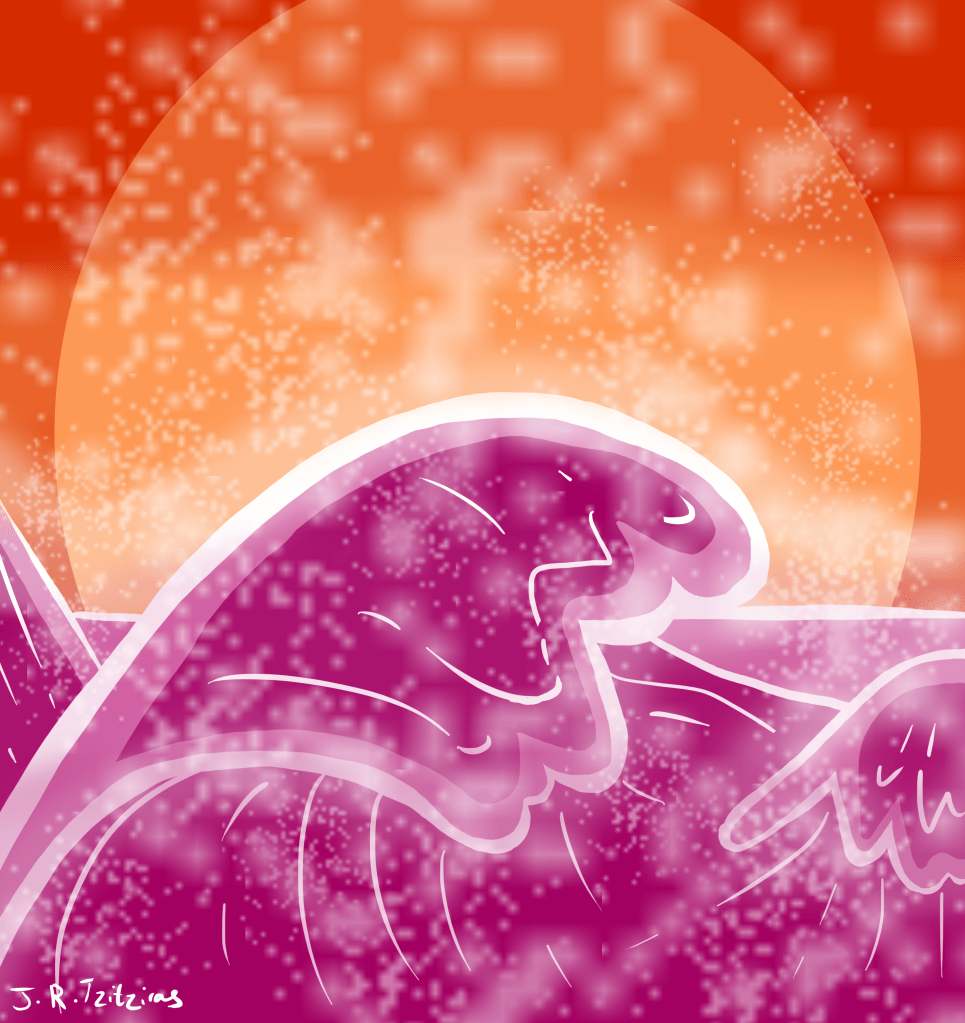
Image description: purple waves swelling up against an orange sun and slightly darker orange sky.
My dad says it’s all about water time – if you want to go pro, that is. His expectations translate smoothly. We have the same dream. It’s my thirteenth birthday and I’m sitting on the couch reading the last chapter of Layne Beachley’s memoir. When I close the book, I get the sense that I’ve accomplished something. I tell my dad that I want to go pro – I’m serious about it. I spend my savings on a second-hand short board because the shorter the board the better the surfer and in the garage, I find a set of 5kg dumbbells. I wipe the yellowish flakes off the handles and display them on my bedside table.
Mum is worried about sharks.
I make a pre-surf routine:
- Bicep curls
- Downward dog
- Visualise myself, carving a 4ft wave while listening to Tame Impala’s song ‘Be Above It’.
I learn that muscle tears before it grows.
I’m under the illusion that I like competition.
*
Can you see it? Dad asks.
We’re sitting on the shoreline watching the sets roll in. He’s trying to show me where the suck rock is – where the waves break on invisible reef. He doesn’t think I’ll get a feel for it unless we sit partially in the water. My surfboard has a swollen nose. A ding has let the water in. I count how many people are out. Forty-nine. It’s too many.
That’s where you wanna be. Right out the back there. His finger makes an imaginary line.
I can’t follow it, though. I’m thinking about what’s under the waters’ surface -– how you can feel and hear the sand shifting when you dive under. My wetsuit pinches and lifts my hip bones. I tug at it as we wade. In the surf, Dad yells to me,
over here – you won’t catch anything in the channel!
He doesn’t realise, yet, that this is the point. I paddle over and tell myself to be brave(before I learn the word anxiety). I can’t duck dive so when a set comes through my board slips out from under me. The tension from my leg rope twists my heel to the sky. When the foam settles, I try again.
Go, go, go.
I can’t tell who says it, but I swing my board around anyway.
*
I’m on the bus, listening to Adele’s twenty-one album, when someone says
I heard you’re training to go pro!
I look behind me and see Tilly, a girl in the year above me, shuffle through bags and lunchboxes. Tilly is beautiful. Her hair is treacle coloured. It folds onto her shoulders (evenly). She leans back on the scratchy blue seat cover next to me. She smiles. She’s genuine and toothy and I forget to answer her question. Are her eyes green or blue? It’s hard to say. I remind myself of something a friend once said,
It’s fine to just, like, appreciate how pretty other girls are.
When in doubt, this helps me to convince myself that I’m not gay. I don’t tell Tilly that I’ve given up. She is a better surfer than me anyway.
*
In PE, our class is playing a game of tag. The air is a thick mix of body odour and Impulse aerosol. It sticks to my white polo. Mascara smudges on our bottom lashes. We’re in pursuit of each other. I’m paired with my best friend Keely. Keely and I surf together on weekends. We carry her dad’s malibu across pine needles to a break called Little Noosa.
In the third quarter of the basketball court, I pull the velcro tag from Keely’s waistband (the premise of the exercise) and she pushes me, playfully, and says,
you’re a lesbian!
We laugh.
What if… I am a lesbian? It’s part confession – part query.
Ew! She pushes me towards the door of the gym. This kind of repulsion is on TV all the time. There is a same sex kiss and then there is shame, rejection, maybe even death.
I feel my mistake in my sweat.
I tell her that I’m kidding, and she says,
Thank god.
It’s years before I try this again.
*
After some googling I find the eBook, The Queer Child, Or Growing up Sideways in the Twentieth Century. The author, Kathryn Bond Stockton, says that growth should be considered as non-linear (I agree and would argue that exponential patterns are generally scary). Why? Because the gay child only exists in retrospect. We are talking about a developmental delay! The gay child is born only after a straight death. First, a child is expected to trial a straight life – to see how it goes.
There is no ceremony after my straight death but there is detective work. I’m searching for early evidence of my gayness so that my childhood feels like my own.
My gay findings:
- We’re in a rental house – on an eastern bloc sofa – when I catch a good ten minutes of a documentary trying to decipher if homosexuality is genetic. At this stage, I think anyone who features in a documentary is sick or sad. I note that the shorts I’m wearing are long and the toys I play with are for boys. I’m seven-years-old. As my mum tucks me into bed, I ask her if she thinks I’m a lesbian. She says no, she doesn’t.
- I can imagine my parents imagining me before I took my first breath. I’m eighteen when I tell my mum that I’m gay and she assures me, in gushy motions, that it is
okay to be gay!
She tells me that before they had children my dad told her he hoped to have a gay child. What a prophecy. I am living out my father’s prophecy!
3. We’re camping with my sisters’ friends and their parents and truth telling around a campfire. There are drinks in the stubby holders and flames licking. It’s all very diplomatic – the parents take turn in telling stories. My dad tells everyone that he once dated a woman who became a lesbian after dating him. Someone says,
you turned her!
Their laughter is the shape of a circle; I’m in the middle but I don’t know it yet.
*
I move away from the beach and into a share house with peeling, vinyl, floors and rat shit in the cupboards. None of this bothers me. My housemates and I clean and fix and hold dinner parties and become best friends. They tell me stories about their parents at anti-war protests in the eighties and I peer into their histories with awe and admiration. It’s misguided. My parents tell me that I look happy.
The household grows to five. On a dry, itchy day I help our new housemate turn the garage into a room. We cover the concrete floor with more vinyl – it’s a different shade of beige. The walls are pine. We remark at how retro it feels. In Just Kids by Patti Smith, I learn that some people dedicate their lives to art. I find this new housemate a practiced creative. We wheel plants down narrow streets with bikes, traffic and kids and giggle about the near misses. We kiss and drive and sleep – and drift from responsibilities. Our love is oversaturated and quiet.
One night, we’re sleeping in the garage-room when the rest of the household come into the room. It’s 3am. They’re giggling and holding a plate of food – one of them says,
It’s chocolate hummus. The plate wobbles.
I rub one eye open. What are you doing?
We just wanted you to know that we know you’re gay. They make an open hand gesture and say,
And that it’s okay!
The next morning, at the non-for-profit café I’m working at, my boss tells me that he imagines me running his café– one day – even if I am a
raging lesbian.
It was an incredible coincidence. I’m not sure how he knew. Sometimes I think about calling up my ex-boss and ex-housemates and letting them know that I’m now a raging lesbian.
*
When I read the book Ethical Loneliness: The Injustice of Not Being Heard, Jill Stauffer’s sentence, ‘in every scene of reconciliation there is a series of bad relationships’, makes me worry about what’s to come (who is there?). For a while, it’s just me and my shame. It has me making decisions that are about me but not for me. It’s a ghost. I want to get rid of it.
In the corner of a party, my friend takes my hand and says,
Try to say the words.
My tongue is trapped between my teeth, but I get out,
I’m a lesbian.
This must be where my straight life died.
It’s not easy, he says.
A couple of weeks later, another friend tells me that I’ll learn who I feel safe around. It’s a truth that asks you to conjure up all your vulnerabilities and wear them but it’s kindred when you’re met with understanding.
On our first holiday, my girlfriend and I travel along the east coast. I drive and she tells me about folk punk bands I’ve never heard of and the injuries she accrued at gigs. Our injuries are different. We share the discomfort and find room in it. It’s a question, at this stage, of how much time have you got?
We get to a cove with a creek and black rocks. In the carpark a truck driver stares at us. It’s raining in sheets, but we slip into our bathers and cross at the shallow part of the creek. The beach is empty – there are no flags or surfboards or children. I don’t miss any of it. This is impossible privacy. Waist deep in the chilly water, I decide that I’m sick of the word lesbian. At least, I want to rethink it. Forsake its curse and threat and absorb it instead. Internalise pride. Let it flow in my blood. This way, I can live in it.
***
Grace Hall is a writer and editor based in Naarm (Melbourne). Her writing explores the joys and pitfalls of growing up queer in rural Victoria. She is fuelled (almost) entirely by potato and existential dread. Grace is a member of the Storming the City Writers group- a Writability program with Writers Victoria.
 Paper Road Magazine