
Christine Segaert
07/11/2026
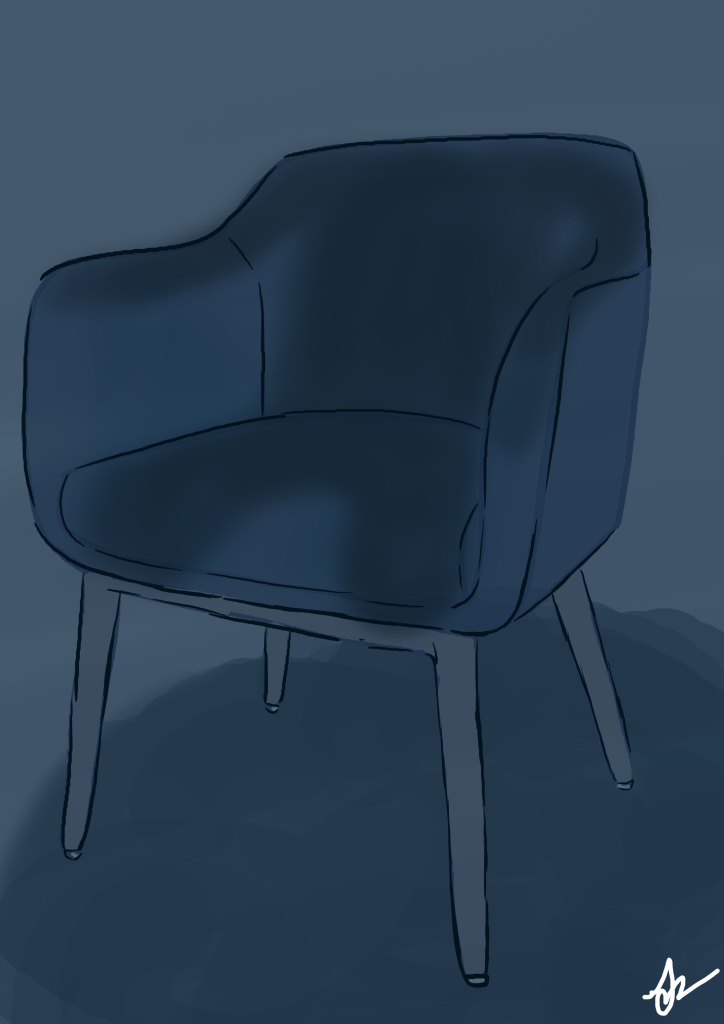
Image description: a solitary chair set against a dark background with the outline of a figure pressed into the chair.
I sat on the one shiny new chair in the waiting room. Shiny and new because there were none like it. My son had laughed when we walked into the waiting room and saw it. The chair I fought so hard for. He knew what it had taken to get this one chair. Only one. One accessible chair in a hospital waiting room. Around me stood uncaring witnesses, the usual narrow waiting-room chairs, cushioned but hemmed in by arms that made them unsuitable for larger bodies. Alongside the small, low lounge that offered another option but also presented another problem: getting a disabled body down was one thing; getting a disabled body back up was another. My eyes drifted to the coffee tables.
Before this new chair arrived, some people had resorted to sitting on them. They had no sides to squeeze against their bodies, but also nothing to push against when they tried to stand. One chair opened up the world of waiting to people otherwise forced into too-small seats, seats and chairs that made it hard to stand after a long wait, chairs that hurt. One chair that was the result of four complaint letters, an unsuccessful appeal to my doctor after another waiting-room chair compressed my hips and worsened my pain, and, finally, raising the issue at a Consumer Committee meeting. The same meeting where staff congratulated themselves on green spaces in mental health accommodation and spoke warmly about seeking more funding to expand the program. So pleased with their plants and flowers. So pleased with themselves. All the while, disabled and larger people were still forced to squeeze into chairs that caused them pain, or to resort to sitting on coffee tables.
Then my name was called, and my son and I left that nice chair behind. My son came to my medical appointments with me as both support and witness. I was a woman over fifty, and I had learned that doctors often treated me differently when there was a man in the room. This would only be the third time I had ever seen the pain doctor. Seven years of waiting. One attempt at the Pain Clinic program, which collapsed when its psychologist left, and the clinic effectively closed for a year. Then I was reassessed and accepted again. Only to be discharged after my second appointment. The discharge letter said I had ‘high pain literacy’, whatever that was supposed to mean. Apparently, knowing too much about the condition I had lived with for years was now a reason not to help me. It took another twelve months to get this appointment with my assigned pain doctor, who had originally referred me to the Pain Clinic program, where hopefully he might help lessen some of the burden of this never-ending pain. The kind of pain that, on most days, made me want to hack my leg off with a blunt butter knife just to make it stop.
There was another person in the room. A woman sat silently across from us in a full set of scrubs and a hairnet, dressed for something far more clinical than an ordinary consultation. She had not been introduced to my son or me; we both were expected to accept this unexplained extra presence in the room. For a moment, I wondered if they were about to do a nerve study or some other procedure, though in the seven years I had been a patient there, they never had.
Eventually, I asked who she was.
‘Someone from the pain clinic,’ the doctor said.
Not a name. Not a role. Not a reason. Just someone. I wondered why she was there. A witness, perhaps? Maybe the doctor involved in my discharge from the Pain Clinic program had warned this outpatient clinic, warned my assigned pain doctor, that I was questioning the decision, and they wanted another person in the room. I did not know. They did not tell me. I had learned not to guess. Too many of their decisions had defied logic or common sense. Guessing meant hoping, and I could no longer afford to do that.
I explained that I had been discharged from the Pain Clinic program and had asked to see him, the referrer, because I needed to find some other help for the pain. He looked confused. Then he turned to my son, not me, and began listing the usual medications that might help someone like me, as though I were not the person sitting in front of him. Only at the end did he add that I was allergic to all of them.
‘Cannabis?’ he asked. I could not afford it at $180 a month.
‘Ketamine cream?’ he asked. At ninety dollars for fifteen millilitres, which only lasted a few days, I could not afford that either.
‘We can’t do anything for you,’ he said at last. It was delivered with the staggering finality of a death sentence.
‘What about guided motor imagery?’ I asked.
He said he did not know who did that in Victoria.
The main public pain specialist for all of Western Victoria, a leader in his field, did not know who practised guided motor imagery in Victoria. Worse than that, he did not care enough to find out. He did not suggest he would look into it. He did not offer to research it. He did not say he would ask around, make enquiries, or try to find someone who might help.
Instead, he said, ‘I will refer you to a private clinic at a private hospital nearby, where they do not do guided motor imagery. Maybe they can help you.’
And that was it. Done. Finished. I was no longer ruining their statistics.
We can’t do anything for you.
The words landed with the force of every other time someone could not help me, or was not even willing to try.
We can’t do anything for you.
And suddenly it was not just that room. Not just that doctor. It was all the other moments rushing back at once. My mother in the back of a taxi during one of her schizophrenic breaks; me, ten years old, dropping her at the local hospital and watching them admit her, then leaving me to walk home alone and look after my little brother. They could help her. They could not do anything for me.
The social workers who sat in my house during family counselling while I begged them to take me into foster care because I was in danger, and they ignored me as if I were background noise. They could hear me. They could not do anything for me.
The officers and superintendents in charge of my local St John Ambulance division knew I was at risk, wanted to help, but did not want to interfere. They could not do anything for me.
More recently, my friends who witnessed family violence and did not want to get involved in ‘family business’, who continued contact with the perpetrator because that was easier than standing beside me. They could not do anything for me.
All of it came roaring back with those six words. Not as memory. As feeling. The sick drop in my stomach. The heat in my chest that rose hot and sharp into my forehead. The old, familiar recognition that once again I had arrived at the outer edge of someone else’s willingness, someone else’s courage, someone else’s system.
So, my son and I walked back to the car. A team of two. No plan. No real next step. Just the familiar weight of being sent away.
And in that moment, I knew I was not the only one they could not help. There were many of us. People too complicated, too costly, too inconvenient, too far outside the script of tidy care. People whose bodies, histories and needs did not fit the systems supposedly built to help them. I felt the weight of that then. Not just my own suffering, but the accumulated weight of all the people who had been told, in one way or another, that nothing more could be done.
That chair had not simply appeared. It was there because I had fought relentlessly for it. One chair in a room full of other chairs. One chair that did not fit. One chair no one had planned for, and perhaps no one particularly wanted there.
Alone, we were all just one chair.
***
Christine Segaert is a disabled writer, artist and PhD student in Creative Writing at Federation University. Based in regional Victoria, her work explores disability, chronic pain, institutional systems, lived experience and advocacy. Her creative practice draws on memoir and autoethnography to examine the ordinary and often hidden labour of survival.

