Kerry O’Connor
28/09/2023
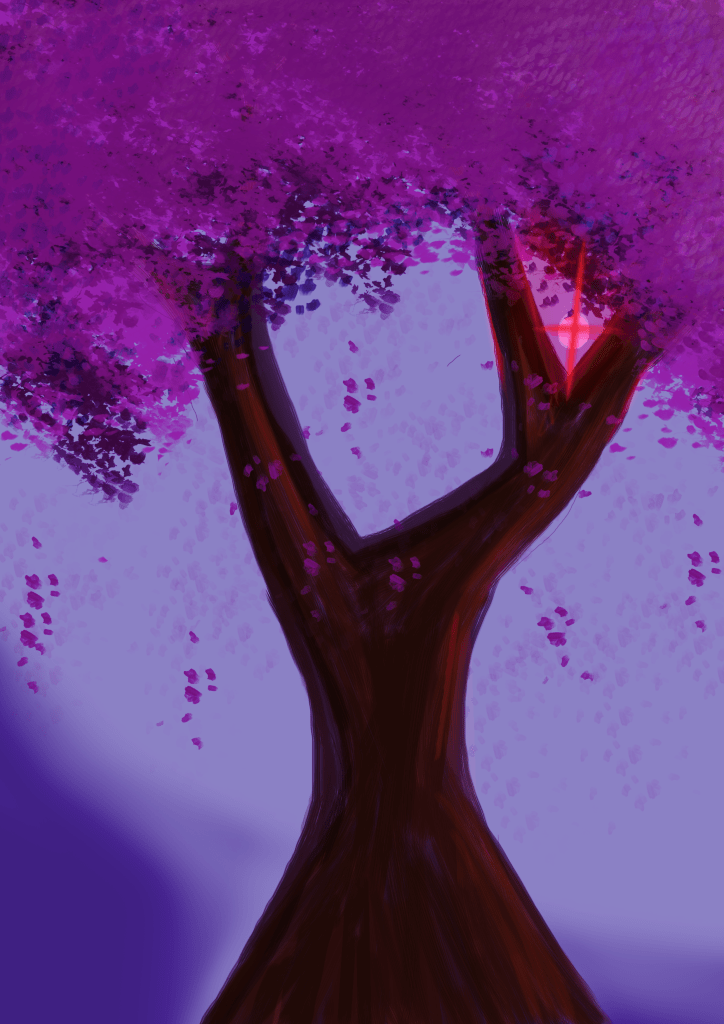
Image description: a tall brown tree with falling purple leaves stands in the foreground as a red glow shines from behind the tree on the right side of the image. The tree is surrounded by a blue-purple background.
For Wally
I am looking for something else when I find the box of kept documents. The green colour has faded over the decades; all the corners have been taped and it is held together with a black ribbon that is knotted, not bowed. The crushed lid speaks to the box’s neglect and as I lift it I am surprised by its heaviness. An eagerness overtakes me to want to open it, to take a walk through time, to another place of youth and turbulence and change.
There are rumblings of change happening in Australia and I listen to conversations on radio, on television and on the internet, conversations about race and division and of a country that needs to face itself and its history. Of a country soon to have a referendum for an Indigenous Voice to Parliament. I hear voices that are hopeful and expectant. Others are angry and resistant. Some are perhaps observing, watching and waiting.
I know this feeling. It’s the feeling that makes me gravitate to the box, undo the knot of black ribbon and gently, with the caution of seeking a lost love, delve inside.
*
I once lived in South Africa. The Republic of South Africa Republiek van Suid-Afrika. I had a green identity book that looks similar to a passport that I applied for in order to stay there. The identity document Identiteitsdokument has a thirteen-digit identity number. It follows a format. The first six digits are based on your date of birth. The next four digits indicate if you are male or female. The next digit shows your status as a citizen or a permanent resident. My number was one, for permanent resident. The next digit was used to classify your race. It is no longer used.
The green identity book is not enforced upon me. I remember the seriousness of having my fingerprints taken. The efforts I went to. The meanings of the numbers, the stamps and the agreements it implied are part of the contract to exist in this world. With that book, with that solemn girl in the black and white photo, with that permission, is the young woman thousands of miles from home, burrowing into a time and place and trying to belong. I’d never felt belonging more than in a South Africa where I had nothing in common with the people.
There is a street in a Johannesburg suburb whose curvatures I can still lean towards and meander round in my memory. Whose Jacaranda trees, tall and ablaze with purple flowers, can still lure me to a steamy afternoon as I stroll towards home. The trees dominate the street, rising to the blue sky and evoke a love of the place that becomes difficult to dislodge. It is spring and the air has warmed and the light moisture seems to paste the flowers to a canvas, stretching into the distance. The serenity and beauty can be inhaled, causing a dreamlike state where hues of purple and blue and pink encircle and chase one another until they drift into the sky above that is waiting to let them in. The petals on the footpaths and roads create a field of purple flowers so that the women with colourful headscarfs carrying heavy bags, and with babies wrapped securely on their backs, appear like apparitions. Only after they pass and I hear the clicking sounds of another language do I feel my soul momentarily askew. It occurs to me that I understand how things work and I also know that I don’t comprehend. People the world over live under governments and systems that slowly emerge or suddenly descend.
The department of Home Affairs Departement van Binnelandse Sake granted me a permanent residence permit less than two years after I moved there. I discover it now in my box of kept documents, still in perfect condition with the signature from the Director-General: Home Affairs Direkteur-generaal: Binnelandse Sake. It has large clear pink stamps on it with the coat of arms, dates, names of cities and departments.
South Africa under apartheid is officially bilingual. The languages of Afrikaans and English are present in all government and public affairs. Signs blend into the streetscape like markings on a highway. Buses. Trains. Toilets. Cinemas. Shops. Schools. Restaurants. Pools. Pubs. Beaches. Lakes. Parks. Blankes. Whites. Slegs Blankes. Whites Only. Blanke Gebied. White Area. Nie-Blankes. Non-Whites.
DF Malan was president of South Africa from 1948 to 1954. During this time the practice of separating people according to race and ethnicity was enforced by law. Laws dictated where people lived, worked, were schooled, and governed every aspect of social and economic life. These laws discriminated against non-white skinned people groups and favoured the freedoms and prosperity of white skinned people.
This is the South Africa I first arrived in from Australia after completing high school. And the South Africa I returned to just over five years later.
Apartheid is an Afrikaans term meaning ‘apart’ or ‘separate’. This form of governing was strictly policed. The Group Areas Act of 1950 determined where people could own property, reside and work. The Population Registration Act of 1950 mandated every South African to carry a government issued identity card. The Pass Laws Act of 1952 imposed a requirement for non-white residents to carry a passbook for identification that monitored and controlled movements. Military rule enforced daily aspects of people’s lives including a curfew when non-white people left the towns and suburbs where they worked to return to their designated places of residence.
I lived in a South Africa where guns were commonplace. Soldiers in khaki and police in blue uniforms walked the streets and were often seen at corners, inside and outside buildings, or driving by. I found myself staring at the uniforms, at the guns, the short haircuts, the rise of the chin, and absorbing the intensity of their presence – maintaining both a reassurance and a wariness toward them. Guns became part of my visual and lingual vocabulary. This became my normal; I walked freely through the streets, a young, white, foreign female. It’s difficult to identify at what point I took comfort in such a presence of power and whether I was aware of the process of desensitisation. I feel so removed from that situation now. How do I admit that I’d never felt safer than in a South Africa full of police and soldiers and guns? At the core of my being, I knew I lived in a volatile place.
I recall one day driving with my boss. I was reaching for something in the console and saw the gun. I did not need to feel the weight of it, the cold metal, or the peculiar groove and shape within my palm to be conscious of its power. A trickle of fear entered me like a needle point and pulled a thread of awareness through me. Almost as quickly it exited, replaced with a wrapping around me of a thicker, sturdier thread of realisation. Self-protection had become a new, silent way of existing. We exchanged a glance but no word was ever spoken.
In his book Disgrace, JM Coetzee exploresthe everyday place of guns in a post-apartheid era. People who had never held a gun were now willing to use them. Protection, defence, retaliation, desperation, fear, hate, power. Living on the cusp of this time, I could sense the nervous tension and the awareness that nobody really knew what was coming.
A photo of my house that I find in my box of kept documents reminds me of a friend I lived with in the Johannesburg suburb of Greenside, and of a night out. It was winter and the night was black and silent. We ventured further out toward the northern suburbs than we usually did. We drove at the speed limit in her mother’s European car and we sensed the drive was taking longer than we were used to. As we slowly ceased laughing and the windscreen began fogging up, I noticed her scanning the outside.
‘Red robot,’ one of us said.
We both tensed and our whiteness dangled a warning in front of us. There had been suggestions of acts of terror targeting white women and our sense of security was limping a little. My friend is not religious but she made the sign of the cross over her chest. We approached the on ramp to the highway and the implicit agreement between us was to keep driving and not stop for the red robot. I had never driven through a red traffic light before. I had never experienced that sickening relief of being safely through. As we turned onto the main road near home I felt fear unwrap my muscles and walk away.
Hijackings became commonplace in South Africa. Not too long afterwards, too many people would tell me stories about sisters or mothers or others that became victims to a new wave of house break-ins, hijackings and rapes. My friend was defiant, refusing to accept a life that was out of her control. Others pondered such actions as a reversal of violence, a punishment of redemption and philosophically tried to cope. South African writer Damon Galgut gives a disturbing account of a hijacking murder in The Promise, and the cheapness of life in the years after apartheid ends. Coetzee portrays a violence and degradation of women that every woman I knew feared. Nestled in suburban Johannesburg, such things were not yet a daily reality. I think now of such vulnerability and of all the women maimed and slaughtered and of the rage that fuelled the country, and the turns of power, and how people can sometimes believe that injustice can be justified. Now, when I have lived for more years than I will still live, I begin to think about such things. I think about how sometimes there is no explanation for the things people do to one another. I think about how people don’t always know why they believe the things they do, and that there are so many versions of truth. Imagine if we were all just good to one another.
*
In my workplace on the seventeenth floor my desk faced the window and I saw over the city’s disused mines and piles of earth dumped. The paleness of sand rose in the distance against the heavy blue sky. Highways and overpasses and long concrete walls divided and barricaded. There were mosaics of tin roofs – the settlements built outside the city – with power lines like spider webs, and everywhere, everywhere, the red soil, indifferent as to where it roamed. I realised I had become an observer. Demonstrations outside thundered a chaos of voices shouting and chanting. Loudspeakers and horns blared a way to my office. The scene of so many people and police and military personnel caused me to momentarily freeze; I only found out the next day that people marched into our building and stormed the foyer but were prevented from entering the lifts. Time to leave.
*
I don’t think I could ever have imagined the South Africa I was entering. I look at the photo in that identity book and I feel a flood of emotions for that young woman who bought a one-way ticket. There’s such concern for the risk she took, such admiration for the courage and determination to change her life story. There’s gratitude to South Africa for allowing a time of exile, a time to breathe.
I understand the irony of having an identity book that allowed me freedoms when the lives of so many were restricted. I don’t feel I have to justify my time there. The things I lived through are locked in my heart and some not ever spoken of. South Africa was my home and is the home of my twenties, and my life is measured by before and after because of the things that changed me.
Jacaranda trees still thrill me. The identity book I will never discard, and I haven’t yet reconciled my views on guns.
I know that some red dust has escaped my soul and made its way into the box and I am content to leave it there, settled between the creases of papers and over the surfaces of photographs. My fingers caress the black silk, papery and delicate and durable.
I tie the black ribbon in a small, neat bow and gently, with the laying aside of a past love, put the box back in the bottom of the drawer.
***
Kerry enjoys pondering a great deal, living in a regional town and taking long walks. She has had articles published in an NGO magazine, been the winner of the Paynesville Short Story Competition and is currently a creative writing student at Federation University.
 Paper Road Magazine