
Shiwani Dhiman
24/10/2026
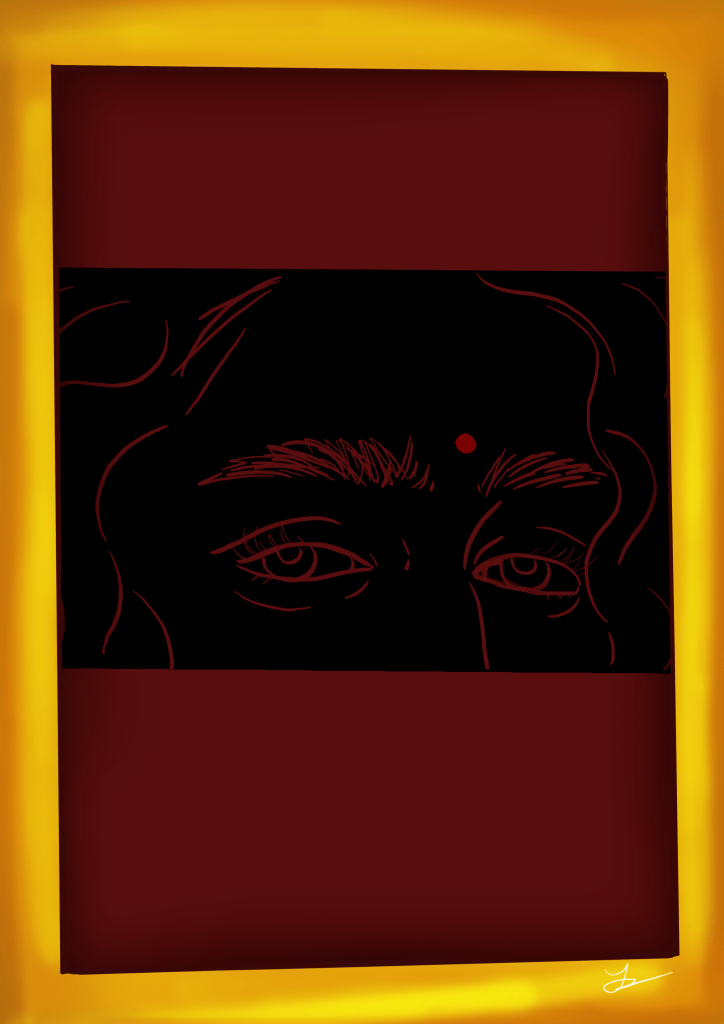
Image description: a woman’s upper face outlined in burgundy set against a vertical rectangle of black and burgundy, with an orange backdrop around the edge.
Since I was a child, I have considered living abroad to be a sign of success. People would point towards a beautiful house and say that the owners’ children were doing well abroad. The difference could be seen in the house, the expensive presents during festivals, and the pride with which the parents praised their children for settling in Canada, the USA, or the UK. The word settled made life abroad sound easy. I grew up in North India, and I imagined living abroad to be connected with better opportunities, education, and infrastructure. We could see what people had gained after moving, but we did not always see what their new life required from them. After becoming a migrant myself, I began to understand the other side. It starts before you even leave, with visa applications, embassy appointments, documents, and waiting. Then the day of the flight arrives. You sit inside the plane knowing that everything familiar is moving farther away. At first, the journey may feel exciting. You watch movies, try the food, and follow the small plane moving across the screen.
After landing, you complete immigration, collect your suitcase, and step into the country where your new life will begin. From the outside, it looks like an arrival. Inside, it can feel like starting from zero. The airport is only the beginning. After you walk through the glass doors, pulling your suitcase behind you, the meaning of migration begins to appear in small, everyday things.
The loneliness no one prepares you for
The first few days abroad can feel exciting, but loneliness slowly begins to enter your life. You realise that no one from your hometown is around. There is no familiar face nearby, no easy visit to family, no old friends, and no relatives who already know your story. Even simple things feel awkward because everything is new, and you are trying to act confident while feeling very unsure inside. This loneliness does not always go away in a few days. Sometimes, it stays for months or even longer. But people do not talk about it much because being abroad is supposed to look like success. It is not easy for everyone to leave home, start from zero in a new country, and manage everything alone.
The foreign language you were never prepared for
Another lie about going abroad is that if you know English, you will manage easily. But the reality is different. In a foreign country, language is not only about speaking. It is about surviving ordinary life. You try to pronounce words correctly so people can understand you, even in English. You translate vegetable names on your phone to check whether they are the same vegetables you knew from your hometown. You read grocery labels slowly. You look at medicine instructions and official letters and wonder whether you have understood them properly. Even buying food becomes a small lesson.
This is when you realise that education does not save you from feeling lost. You may have degrees, you may know English, you may be confident in your own country, but abroad, you can still feel like a beginner. The world around you becomes official in a language your childhood, friends, and neighbours never prepared you for.
When you have to mother yourself
Independence does not always feel good, especially when you are sick. Once, I had a high fever and a terrible headache. My parents were not there to check my temperature, cook something simple for me, or ask if I was feeling better. I had to get out of bed and make food for myself, even though I hardly had the energy. That day, I understood what it means to mother yourself. You have to notice your own weakness, take care of yourself, and tell yourself that you will be fine. When my parents called, I smiled and said I was okay because I didn’t want them to worry. After I ended the call, I felt lonely again. I knew they cared about me, but they were too far away to see how I was actually feeling. Sometimes, living abroad means giving yourself the care that you miss from home.
People think we become detached
People think that those who go abroad become detached and very different. They think we don’t care much about everyday emotions, family functions, birthdays, or small occasions back home. They think we call less often and rarely return for family occasions because those moments no longer matter to us. But when I became a migrant myself, I understood that this was only half of the reality. People abroad also miss celebrations. They miss festivals. They miss the noise of home, the preparation before a function, the relatives coming and going, the food being cooked, the clothes being selected, the small arguments, the laughter, everything. Maybe they cannot always come back for every occasion, but that does not mean they do not feel anything. Sometimes they start celebrating the same festivals in their own small way. I feel this distance especially during Teej, a festival close to my heart. Back home, everyone gets together, shares sweets and enjoys the warmth of being with family. Here in the Netherlands, it can pass like an ordinary day. I may speak to my family or see their photographs, but I still miss being there with them.
People abroad also carry many emotions. They miss their family in small moments of the day. I miss my mum and dad, my brother, and my sister every day. Maybe only for a few minutes at a time, but I think of them daily. That does not mean I am detached. My body may be in another country, but some part of me still lives at home.
What I understand now
Living abroad has not always been difficult. I have seen new places, met different people, and learned to manage many things by myself. But I wish we spoke more honestly about what happens after someone moves. A new country does not immediately feel familiar. It takes time to understand the language, the people, and the ways of everyday life. When someone tells me that I am lucky to live abroad, I smile because I know both sides of it. They see the country where I live. I remember the lonely days, the unfamiliar words, and all the small things I had to learn by myself; so maybe this is what moving abroad really means. You do not leave your old life completely behind, and you do not immediately belong to the new one. For some time, you live somewhere in between, slowly learning how to make a place for yourself.
***
Shiwani Dhiman is a creative and life writer with a background in literary and reflective storytelling. She holds a master’s degree in English from Kurukshetra University. Currently residing in the Netherlands, she writes about migration, marriage, and belonging. Her work has appeared in The Write Launch, Brevity Blog, High North News, and others. Follow her journey on substack: https://substack.com/@shiwanidhiman

